
The Fastest, Most Accurate Way to Test for Lead Paint — Without Damaging a Single Surface
XRF lead paint inspection gives you a definitive, room-by-room picture of lead paint conditions in a single visit — no chip samples, no lab wait, no guesswork about which surfaces were tested.
What XRF Lead Testing Actually Does
X-ray fluorescence (XRF) testing uses a handheld device that emits a low-level X-ray beam and reads the fluorescent energy reflected back from the surface. That reflected signal identifies the elemental composition of the paint layers beneath — including lead — without scratching, chipping, or disturbing anything. The instrument gives a reading in seconds, and a trained inspector can move through an entire apartment or building systematically, logging every surface as it's tested.
The result is a complete, surface-by-surface lead paint survey that holds up under regulatory review, satisfies HPD documentation requirements, and, when conditions warrant, stands up in litigation. This is not a screening tool. It is a definitive inspection method recognized by the EPA and HUD as the gold standard for lead paint identification.
What an XRF Inspection Covers
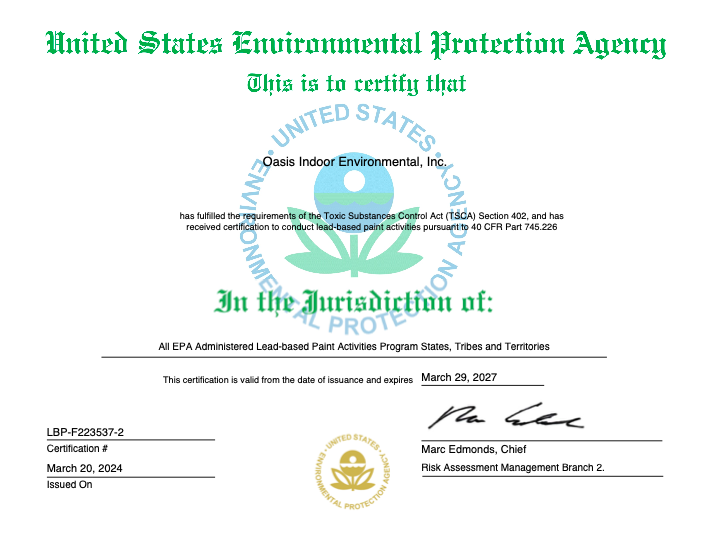
Every XRF lead paint inspection from Oasis Indoor Environmental is conducted by an EPA-certified lead inspector. We test painted surfaces systematically — walls, trim, doors, windows, sills, soffits, baseboards, and any other component that may have been painted at any point in the building's history. Nothing is assumed clean because it looks clean.
Why XRF Is the Right Method for NYC Properties
New York City's housing stock is old. The vast majority of buildings constructed before 1978 contain some lead-based paint, and many pre-1940 buildings have it on nearly every painted surface. Chip sampling and paint chip lab analysis can tell you whether lead is present on a specific surface — but only if you know exactly where to sample and are willing to damage the surface to get there. XRF covers the entire unit, every component, every room, in a fraction of the time.
For landlords facing Local Law 31 deadlines, property managers responding to HPD violations, or homeowners who need to know what they're dealing with before a renovation, XRF delivers the comprehensive documentation that partial sampling never can.
Complete Surface-by-Surface Documentation
Every surface tested is logged with its location, component type, and XRF reading. The final report identifies each surface as positive, negative, or inconclusive for lead-based paint, with the specific concentration recorded. There is no ambiguity about what was tested and what the result was.
EPA-Certified Inspectors, Not Technicians
Our XRF inspections are conducted by EPA-certified lead inspectors — a credential that requires formal training, a federal examination, and ongoing continuing education. Certification matters because it determines what the report is legally worth. An inspection performed by an uncertified technician cannot satisfy Local Law 31 requirements, HPD documentation demands, or HUD compliance standards.
Litigation-Ready Reporting
Every report we issue is written to document what can be proven, not just what was observed. Chain of custody, instrument calibration records, inspector credentials, surface-by-surface readings, and a clear methodology section are all included. If a report ever needs to support a legal proceeding, a regulatory appeal, or a dispute between landlord and tenant, it is built to hold up.
Results the Same Day
XRF instruments produce readings in real time. In most cases, we can provide a preliminary verbal summary of findings before we leave the property, with the full written report to follow. For landlords and property managers working against HPD deadlines, that turnaround matters.
Who Requests XRF Lead Paint Inspections
XRF lead paint testing serves a wide range of clients across the NY metro area, and the reason for the inspection shapes what the report needs to accomplish.
- Landlords and property managers confirming compliance with Local Law 31 before the deadline or responding to an HPD lead paint violation
- Homeowners planning a renovation who need to know which surfaces contain lead before work begins — and before a contractor disturbs them
- Buyers and sellers whose real estate transaction requires a lead inspection as a condition of sale or financing
- Tenants who want independent documentation of lead paint conditions in their unit, separate from any inspection the landlord may have commissioned
- Property owners pursuing clearance after lead paint abatement has been completed
Common Questions About XRF Lead Testing
What is an XRF lead inspection and how is it different from a paint chip test?
XRF stands for X-ray fluorescence. The inspector uses a handheld device to scan painted surfaces and measure the concentration of lead in the paint layers without disturbing the surface. A paint chip test requires physically removing a sample and sending it to a lab, which means surface damage, a waiting period, and limited coverage. XRF is faster, non-destructive, and covers every surface in the space rather than a selected few.How long does XRF lead testing take per unit?
A typical residential apartment takes between one and two hours, depending on size and the number of surfaces present. Larger units, multi-room commercial spaces, or buildings with complex histories may take longer. We can give you a more specific estimate once we know the property details.Does XRF testing satisfy NYC's Local Law 31 requirements?
Yes. XRF inspection conducted by an EPA-certified lead inspector is the recognized method for satisfying Local Law 31 documentation requirements. The law requires that owners of pre-1960 buildings — and pre-1978 buildings where a child under six resides — inspect all dwelling units for lead-based paint hazards. XRF is the method that produces the surface-by-surface documentation the law requires.Is XRF testing safe for occupants and the building?
Yes. The X-ray beam used in XRF testing is low-level and localized. The instrument is held against the surface being tested, and the exposure to surrounding occupants is negligible. No surfaces are damaged, no dust is generated, and no chemicals are used. Occupants can typically remain in the space during testing.