
What a Lead Hazard Risk Assessment Actually Tells You — and Why It Matters More Than a Basic Paint Test
A lead risk assessment goes further than identifying where lead paint exists. It determines whether lead in your home is actively creating exposure risk for the people living there — and documents it in a form that holds up when decisions need to be made.
The Difference Between a Lead Inspection and a Lead Risk Assessment
A lead inspection answers one question: is lead-based paint present? A lead hazard risk assessment answers a different and more consequential question: is the lead present creating a hazard right now?
The risk assessment process evaluates lead paint condition, lead dust levels on floors and windowsills, lead in soil around the property, and any deteriorated surfaces where lead is likely to become airborne or ingested. The result is a written report that classifies each identified hazard, assigns a risk level, and recommends specific corrective actions — prioritized by urgency.
For families with young children, pregnant women, or anyone with documented lead exposure, this is the assessment that gives you actionable information rather than just a presence-or-absence answer.
Who Typically Needs a Risk Assessment
Lead hazard analysis serves a specific set of situations where a basic paint screen isn't enough.
What the Assessment Covers
A lead hazard risk assessment conducted by Oasis Indoor Environmental includes a systematic evaluation of every potential exposure pathway in the property.
The scope includes:
- Visual inspection of all painted surfaces for deterioration, chipping, chalking, and friction points
- XRF lead paint testing on suspect surfaces throughout the structure
- Lead dust wipe sampling from floors, windowsills, and window wells — the surfaces where lead dust accumulates and children come into contact with it most
- Soil sampling at exterior areas where children play or where painted surfaces have shed over time
- Review of renovation history and any previous lead testing records
- Written report with hazard classification, risk ranking, and recommended corrective actions
Every component is documented with field data, laboratory results, and chain-of-custody records. The report is written to a litigation-ready standard.
Families with Children Under Six
Young children face the highest biological risk from lead exposure. If you have a child under six living in or regularly visiting a pre-1978 home, a risk assessment identifies which surfaces and areas present active hazard — not just which ones contain lead.
Pregnant Women and Expecting Parents
Lead exposure during pregnancy carries documented risks for fetal development. Many of our risk assessment calls come from expecting parents who want a complete picture of their home environment before a baby arrives — not a partial answer.
Properties with a Child with Elevated Blood Lead Levels
When a child has tested positive for elevated blood lead levels, a risk assessment is typically the required next step. It identifies the likely source, documents the hazard, and provides the evidence base for remediation planning and follow-up clearance testing.
Landlords Responding to HPD Violations or Complaints
A lead hazard risk assessment provides the independent documentation landlords need when responding to HPD lead violations, tenant complaints, or Local Law 31 compliance obligations. Because Oasis performs inspection only — no remediation — the findings carry the credibility of a true third party.
Why Independent Assessment Matters
Oasis Indoor Environmental performs inspection and assessment only. We do not perform remediation, and we have no financial relationship with any remediation contractor.
In New York State, mold assessors and remediators are legally required to be separate entities — and while that specific statute applies to mold, the principle is equally important in lead work. When the company assessing your property also sells remediation services, the incentive structure is misaligned. Our only deliverable is an accurate report. We have nothing to gain from finding more than is there, and nothing to gain from minimizing a genuine hazard.
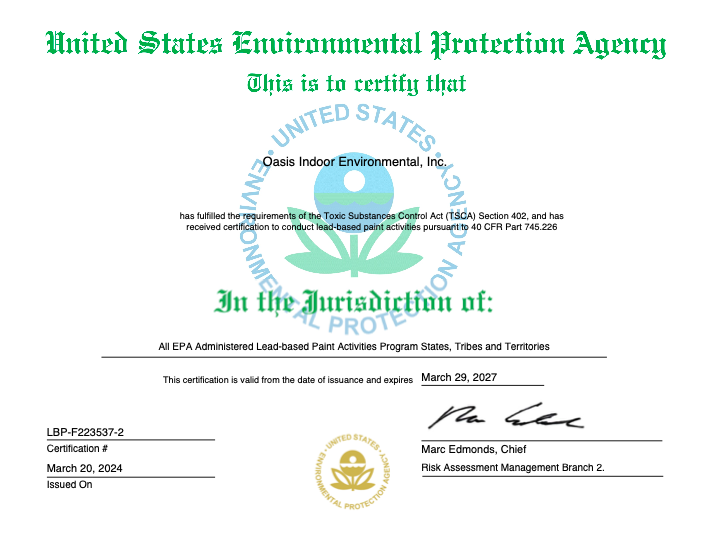
Spencer Hampy, the company's president and a certified lead inspector with EPA credentials, personally reviews findings with clients and walks them through what the report means in plain language — not just what was found, but what it means for the people living in the space and what the realistic options are.
Common Questions About Lead Risk Assessments
What is a lead hazard risk assessment, and how is it different from a lead inspection?
A lead inspection determines whether lead-based paint is present in a structure. A lead hazard risk assessment goes further — it evaluates whether the lead present is creating an active exposure hazard through deteriorated paint, lead dust accumulation, or contaminated soil. The risk assessment produces a written report that classifies hazards by severity and recommends corrective actions in priority order.Do I need a risk assessment if I have small children?
If you have children under six living in a pre-1978 home, a risk assessment is the most informative step you can take. It identifies not just where lead paint exists but where it is creating dust or deterioration that puts children at risk. A basic paint screen tells you lead is present — a risk assessment tells you whether it's a problem right now and where to focus.What does lead dust testing involve?
Lead dust testing uses wipe samples collected from floors, windowsills, and window wells — the surfaces where lead dust settles and where young children are most likely to come into contact with it. The samples are sent to an accredited laboratory, and results are compared against EPA clearance standards to determine whether levels present a hazard.How long does a lead hazard risk assessment take, and when will I receive the report?
Assessment time varies by property size, but most residential properties can be completed in two to four hours. Laboratory analysis for dust and soil samples typically takes three to five business days. The written report, including hazard classification and recommendations, is delivered once all lab results are received and reviewed.